

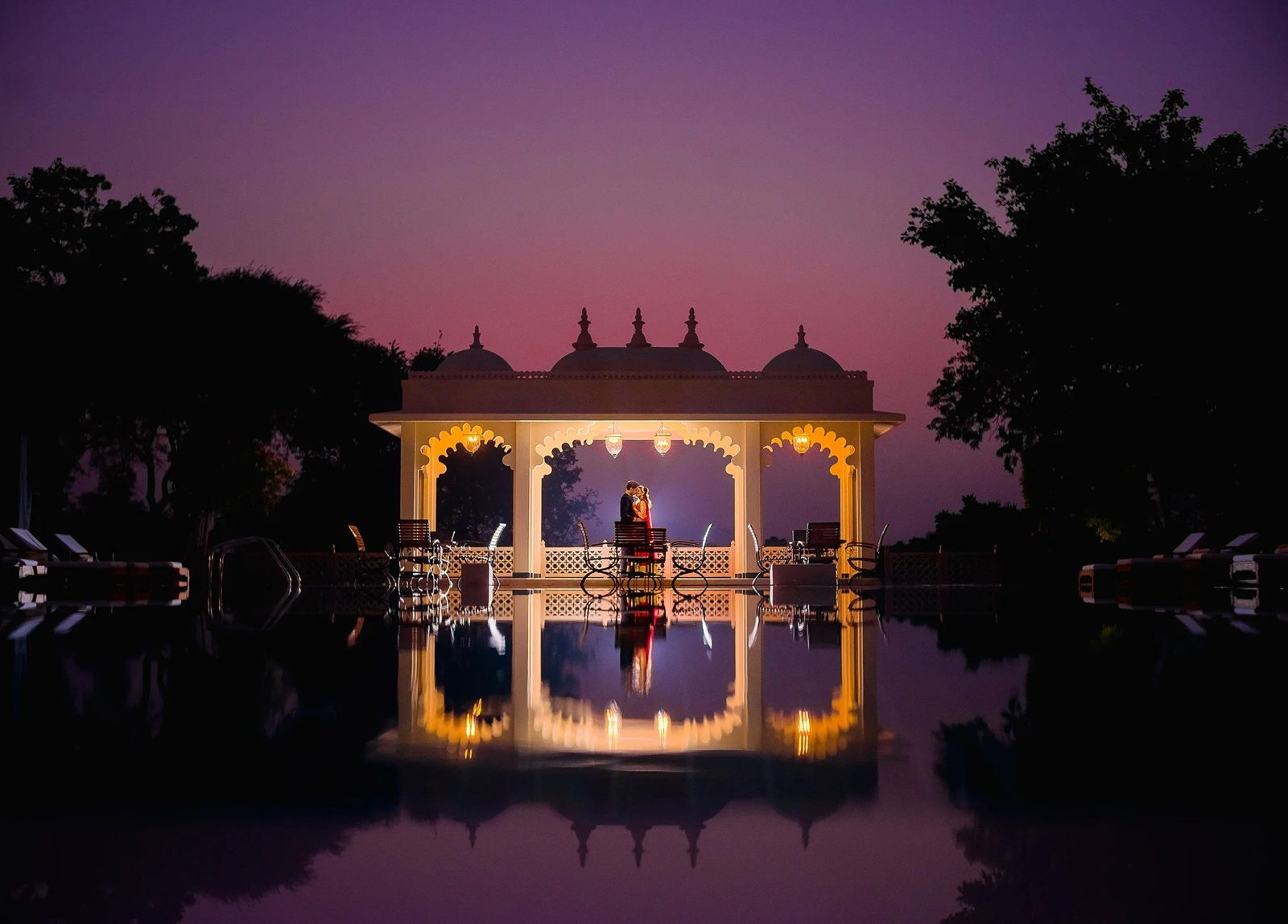
The big fat Indian wedding still looks familiar from the outside. Guest lists in the hundreds, three or four days of functions, heavy décor, and the expectation that everyone who should be invited will be invited. Those elements have not gone away. What has shifted is the conversation happening underneath them, about pacing, about what the money is actually buying, and about how much of the old formula still needs to be followed. Average spend in metro and urban markets has moved into the ₹45–55 lakh range. Luxury and destination weddings routinely cross ₹80 lakh and often go well beyond. The growth is real, but it is not evenly distributed across the same old categories. More of the budget is moving toward things guests actually feel and remember, and less is being spent on simply making everything larger.
What Defines the Big Fat Indian Wedding Today?
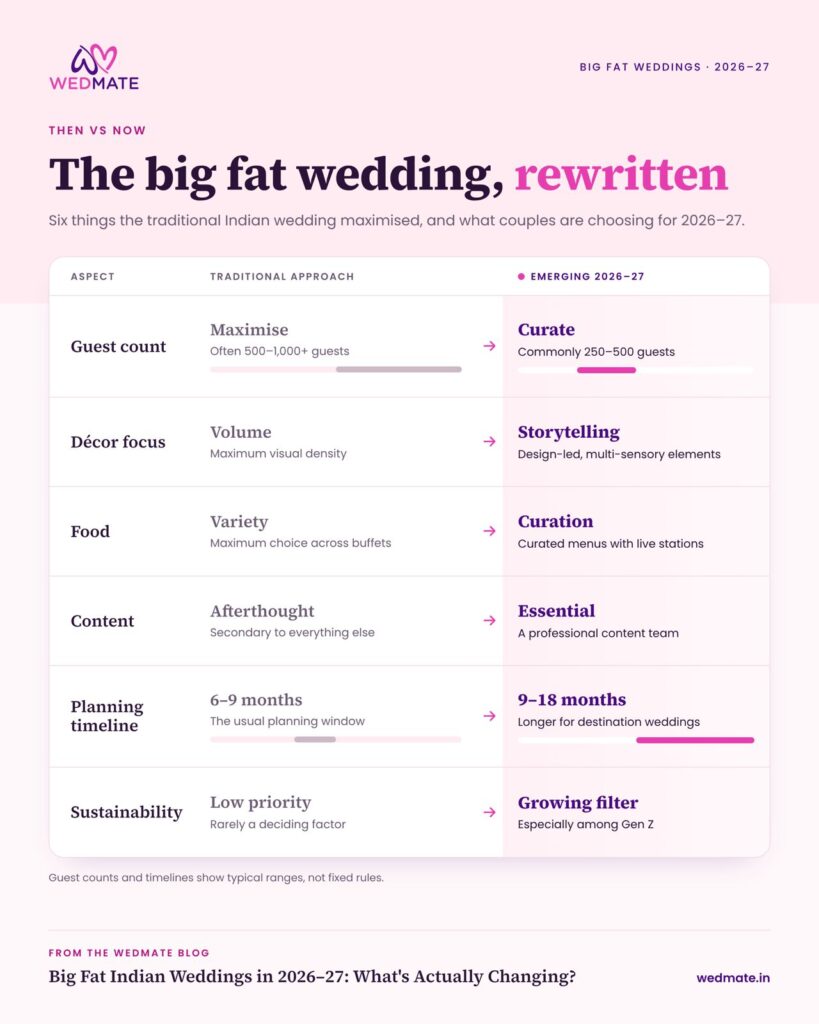
A typical big fat Indian wedding still includes multiple functions spread across three or more days, commonly a welcome event, mehendi, sangeet, the wedding ceremony, and a reception. Guest counts in the luxury segment generally fall between 300 and 600, though some communities and cities continue to host larger gatherings. The format serves both personal and social purposes: it accommodates extended family networks, professional relationships, and community obligations while creating a visible sense of occasion. Multi-day celebrations account for more than 70 percent of weddings in the premium segment. This structure has remained stable, but the internal pacing and design of these days are becoming more deliberate. The expectation is no longer simply that every function must be larger than the last.
What are Major Shifts Happening Now?
From volume to curated experience
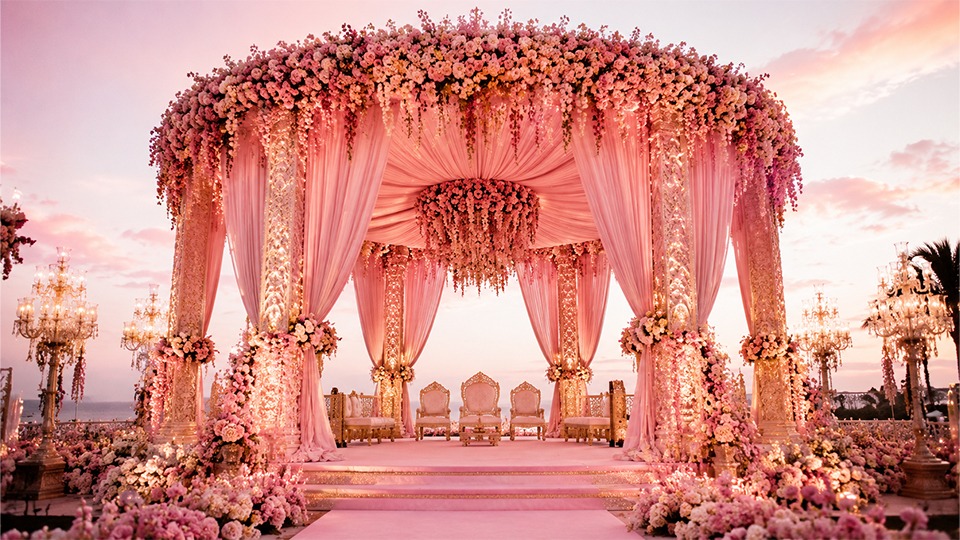
Couples are reducing emphasis on maximum guest counts and maximum décor volume. Instead, there is greater focus on the quality of individual moments — intimate welcome dinners, better pacing between functions, and design that feels intentional rather than purely abundant. This does not mean weddings are becoming small; it means scale is being applied more selectively.
Destination weddings are growing faster than traditional city formats
The projected rise from roughly 25–28 percent to 30–35 percent by 2028 is driven by practical advantages. Moving the wedding to Udaipur, Jaipur, Goa, or similar locations naturally limits the guest list and allows higher standards of accommodation and experience. Infrastructure in these destinations has also improved, making multi-day resort or palace formats more reliable.
Gen Z couples are changing decision-making
Younger couples are entering the planning process earlier and with clearer preferences. They place higher priority on personalisation, content-ready environments, and sustainability. In many families, they now share or lead budget decisions rather than simply approving choices made by parents.
Content and guest experience have become core spends
Professional photography and videography teams, along with deliberate guest comfort measures (better room experiences, reduced event fatigue, thoughtful hospitality), are no longer treated as add-ons. Technology such as guest management systems and live streaming for relatives abroad has moved into standard infrastructure.
Quiet luxury is influencing rather than replacing scale.
Many couples still want a large celebration but are applying principles of better materials, stronger visual storytelling, and higher guest comfort. The result is a hybrid: recognisable big fat wedding markers executed with greater rest
Where Does the Money Go Differently?
In the ₹80 lakh to ₹2 crore band, venue and accommodation still take the largest share, especially for destination weddings. Décor remains significant, but the brief has changed. Clients are less interested in covering every surface and more interested in whether the design holds together across the days and photographs cleanly from multiple angles. Food budgets are holding, yet the emphasis has moved toward live stations and genuine dietary range rather than maximum number of dishes. The clearest increase is in content and guest experience. Professional photography and video teams are no longer treated as a separate line that can be reduced late. Guest comfort — better rooms, sensible schedules, proper airport and transfer handling — is being protected even when other areas are trimmed. Contingency is also being set higher. The old habit of keeping 5 percent aside is proving insufficient when hospitality and design costs keep rising; 8–12 percent is becoming the more realistic buffer. Destination weddings already account for roughly a quarter of the market and are expected to move toward 30–35 percent by 2028. The growth is not only about beaches or palaces. It is about control. A city wedding often expands because saying no is socially difficult. A destination wedding creates a natural boundary.
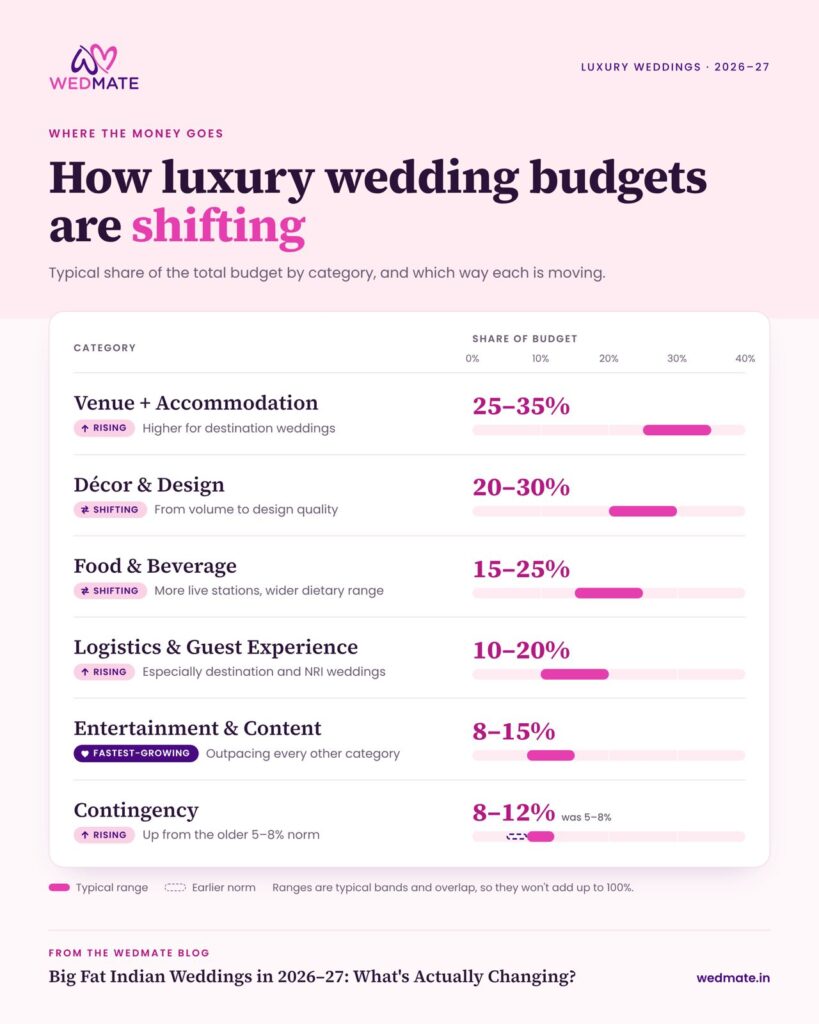
Destination weddings allocate a larger combined share to venue, accommodation, and logistics. City weddings continue to weigh venues and décor more heavily. Across both, contingency buffers are being set higher because of sustained inflation in hospitality and design services
Gen Z Is Not Rejecting the Format. They Are Editing It.
Younger couples are not walking away from large weddings. They are, however, entering the process earlier and with stronger opinions about what should be kept. Personalisation that goes beyond monogrammed napkins, spaces that work for photography without looking staged, and a lower tolerance for elements that exist only because “this is how it has always been done” are showing up repeatedly. Sustainability is part of the filter for many of them, but it rarely appears as a slogan. It appears as a question: does this particular choice need to be this large, or this wasteful, to achieve the effect? In a growing number of families, these couples are also closer to the budget decisions than they were a few years ago. That changes the negotiation. Parents may still drive the guest list and certain rituals. The couple is more likely to influence design language, content, and the overall pace.
What Couples and Families Are Actually Deciding Earlier?
The weddings that run into the least friction are usually the ones where a few priorities are settled before venues are locked. Is the non-negotiable a certain guest count, a particular design feel, strong content, or guest comfort across multiple days? Once that is clear, trade-offs become easier. Trying to maximise all of them at once is what pushes timelines and budgets into difficulty. Destination dates in peak season need longer lead times, often 12 to 18 months, because good room blocks and preferred venues move early. City weddings can sometimes move faster, but popular weekends still disappear. Families who treat content and guest logistics as core rather than residual items also tend to avoid the late scramble that used to be common. The traditional markers of a big fat wedding are still available to anyone who wants them. The difference in 2026–27 is that fewer people are treating every marker as mandatory.
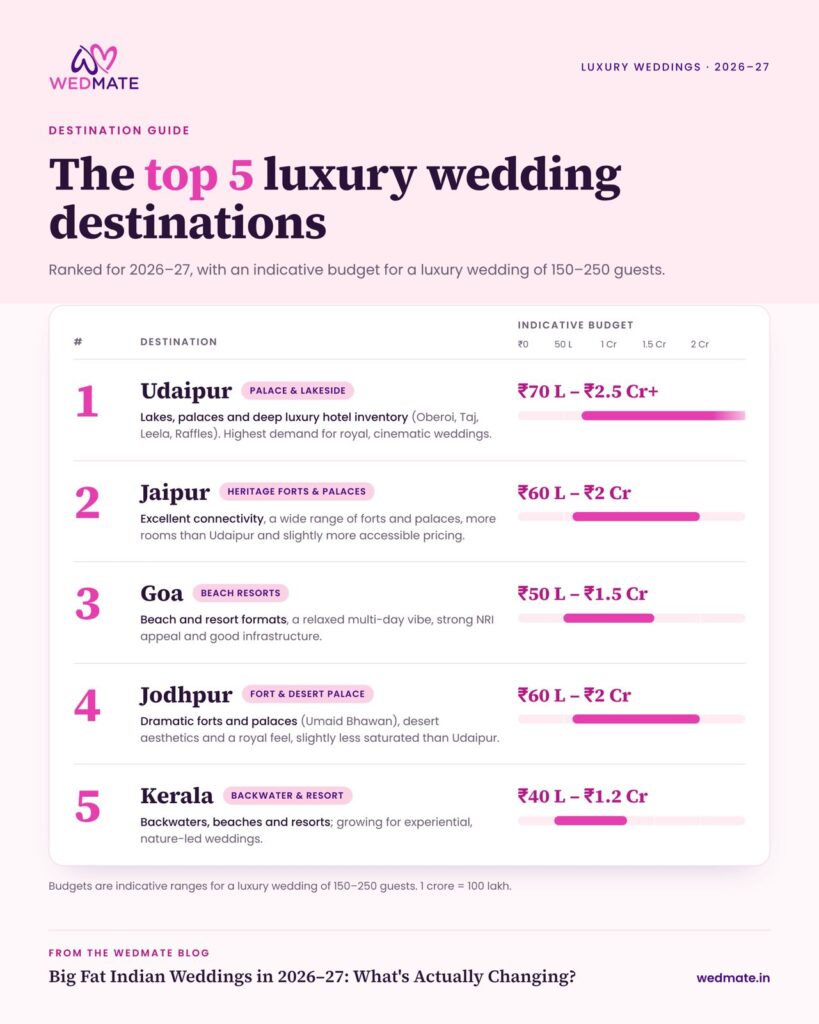
What are the Top 5 Popular Wedding Destinations in India?
Based on industry reports, planner surveys, and consistent rankings across sources, these are the most popular destination wedding locations in India right now:
Role of Wedding Planners in Big Fat and Destination Weddings
In large-format and destination weddings, the planner acts as the central coordinator linking venue, vendors, design, hospitality, and timelines. These celebrations typically run across multiple days with guest counts of 300–600 (and sometimes higher), often in a location away from the couple’s home city. The volume of interdependent decisions increases significantly, and the planner’s main contribution is reducing execution risk while keeping all elements aligned.
Key responsibilities of wedding planners in this segment usually include:
Venue and contract management: Shortlisting suitable palace hotels, resorts, or large city venues; negotiating room blocks, exclusivity terms, and function timings; and confirming the property can support the required guest count and ritual needs.
Vendor orchestration: Selecting and managing caterers, decorators, entertainment, photographers, and logistics partners experienced with high-volume, multi-day events. This is especially relevant in destinations such as Udaipur, Jaipur, and Goa, where local vendor quality and peak-season availability vary.
Guest logistics and hospitality: Coordinating airport transfers, room allocation, welcome arrangements, and daily movement between functions — details that become critical once guests are travelling.
Design and flow consistency: Ensuring décor, lighting, and pacing work coherently across different functions instead of treating each event separately.
On-ground execution and contingency: Maintaining the run-of-show, managing last-minute adjustments, and handling the higher operational load that comes with scale and destination settings.
Remote coordination: Providing structured updates, visual approvals, and a single point of contact for NRI or outstation couples so decisions can proceed without repeated travel.
Families typically engage an experienced planner for these weddings to protect both budget and guest experience. Venue and vendor contracts at the luxury level involve large financial commitments; unclear scope or weak coordination can lead to overruns or compromised delivery. Planners familiar with major destination circuits bring existing relationships and knowledge of local constraints such as permissions, peak-season pressure, and property-specific rules. This reduces friction compared with building the same team independently. The role centres on integrating venue capability, vendor execution, guest movement, and design into one workable plan, particularly when the wedding spans several days and a large number of guests.
Conclusion
The big fat Indian wedding continues to operate at significant scale, with multi-day formats, substantial guest lists, and sustained spending remaining central to the segment. Destination weddings form a major part of this market, particularly in established circuits such as Udaipur, Jaipur, and Goa. In these celebrations, the wedding planner plays a precise operational role: coordinating venue contracts and room blocks, managing high-volume vendors, aligning design and pacing across functions, and handling guest logistics and on-ground execution. This coordination becomes especially relevant when the wedding involves travel, multiple days, and large numbers of guests, as it reduces fragmentation across vendors and protects both budget and delivery. Families that define priorities early and work with planners experienced in these formats are better positioned to execute the wedding within its intended scope.

Reader conversations (0)